Brimbank Bin Hire
By Brimbank Bin Hire - October 2025
When you hire a skip bin for a home clean-up, renovation or business site you naturally expect it to be placed on your property. But what happens if the bin ends up on the street outside your house, or even outside your neighbour’s property? What if you live in a strata or shared property and the skip is placed on common land? These situations raise questions about permits, placement rules, liability and neighbour relations. Knowing what applies helps you make an informed decision and avoid unexpected issues.
Private Property Placement Means No Permit in Most Cases
If the skip bin is placed entirely on your private land, for example your driveway, garage forecourt or backyard area, you ordinarily do not require a council permit. This is because the bin remains on land you control and local laws treat it differently than when it is placed on public land. By staying on your own property you minimise risk of obstruction, fines or neighbour complaints.
When Placement Moves to the Street or Nature Strip
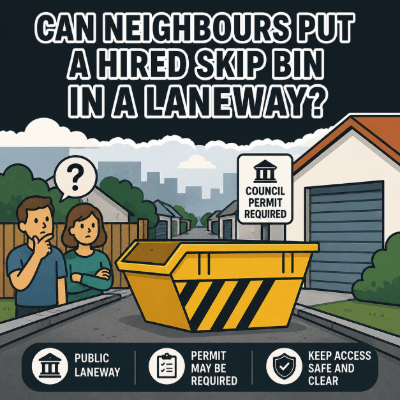
In many urban and suburban situations your driveway may not be wide enough or there may be overhanging cables, trees or parking restrictions that prevent a safe or convenient placement. In such cases your skip bin might need to be placed on the road, nature strip or footpath outside your house. In the Brimbank City area, local councils rules clearly stipulate that bins placed on public land will usually require a skip permit. See official Brimbank permit information here.
Neighbour consent becomes more relevant in these scenarios since your skip occupies public space adjacent to other properties. The permit process may require notification of nearby properties or proof of safe access and visibility standards.
Shared Property and Strata Contexts
If you live in a unit, apartment, townhouse or other strata scheme then placing a skip bin may involve common property rules. The nature strip, driveway, loading bay or setback area may be managed by the owners corporation. Before you book a skip you should check:
- Who controls the common area and whether placement is permitted there.
- Whether the skip hire company has access rights and clearance for the truck delivery.
- Whether vehicle turn-around, safe pedestrian access and no obstruction to other residents will be maintained.
Failing to obtain approval from the owners corporation or strata committee can lead to delays, objections from neighbours or even removal of the skip by local authorities.
Neighbour Relations and Practical Considerations
Even when placement is technically permitted, good neighbour relations matter. Having a skip outside your house or in front of a neighbour’s property can block views, restrict parking and create noise or odour concerns. It is good practice to:
- Inform nearby neighbours of your skip booking and expected dates.
- Ensure the skip company places signage, cones or lighting if the bin is on the street.
- Arrange delivery and collection for times of day when traffic and pedestrian access is minimal.
- Ensure the skip is not overflowing, spilling debris or blocking drains or footpaths.
Brimbank Council Permit Rules for Public Land Placement
When the skip bin is on public land such as a road, nature strip or footpath a permit is almost always required. For example the City of Brimbank clearly states that a skip cannot be placed on the road until a skip permit is issued.
Permit rules often include:
- Clearance for pedestrians and vehicle sight lines.
- Marking of the skip with contact information, reflective tape and ownership details.
- Fees based on number of parking bays occupied, size of bin, location and duration.
If a skip is placed without a permit, fines can apply and placement may be delayed or removed by the council. It is typically the skip hire company that arranges the permit but you as the customer should confirm this responsibility.
What to Check Before Neighbours’ Skip Bins Appear Outside Your Home
As a homeowner you might wonder whether a skip outside your neighbour’s house is allowed. Key things to check are:
- Is the skip on private land or public land? If on public land then a permit should be in place.
- Is there visible signage on the skip with company name and contact details? This is often required by council.
- Is the skip blocking driveways, footpaths or fire access lanes? Local laws typically require clear access.
- Has the skip hire company obtained public liability insurance and traffic management equipment if required?
If you are concerned that a neighbour’s skip is placed illegally you can contact the local council and provide the address and photograph, they can check whether a permit exists and whether it meets conditions.
Delivery Access in Tight or Constrained Areas
Many delivery trucks require a minimum width of approximately 2.5 to 3 metres to safely reverse and place the bin without obstructing other traffic or risking damage. If your driveway is narrow, has overhanging trees or is shared you may need to place the skip on the street. In such cases the permit and neighbour consultation become more important.
Strata and Shared Driveway Special Cases
In a multi-unit complex skip placement must account for shared spaces, parking bays, pedestrian access and deliveries for other residents. The owners corporation may require a different permit or insurance coverage. Placement may only be permitted in certain zones or after hours to avoid conflict with other residents.
“Skip bin placement is more than logistics it is about access, safety, neighbourhood courtesy and compliance.”
How Can We Help You?
We at Brimbank Bin Hire advise you on the best skip bin placement based on your property and access. We check whether a permit is required, assist with paperwork and ensure the bin is delivered safely with minimal disruption to neighbours. Whether it is driveway placement, street placement or complex strata situation we handle the details so your project remains on schedule.